

About the company
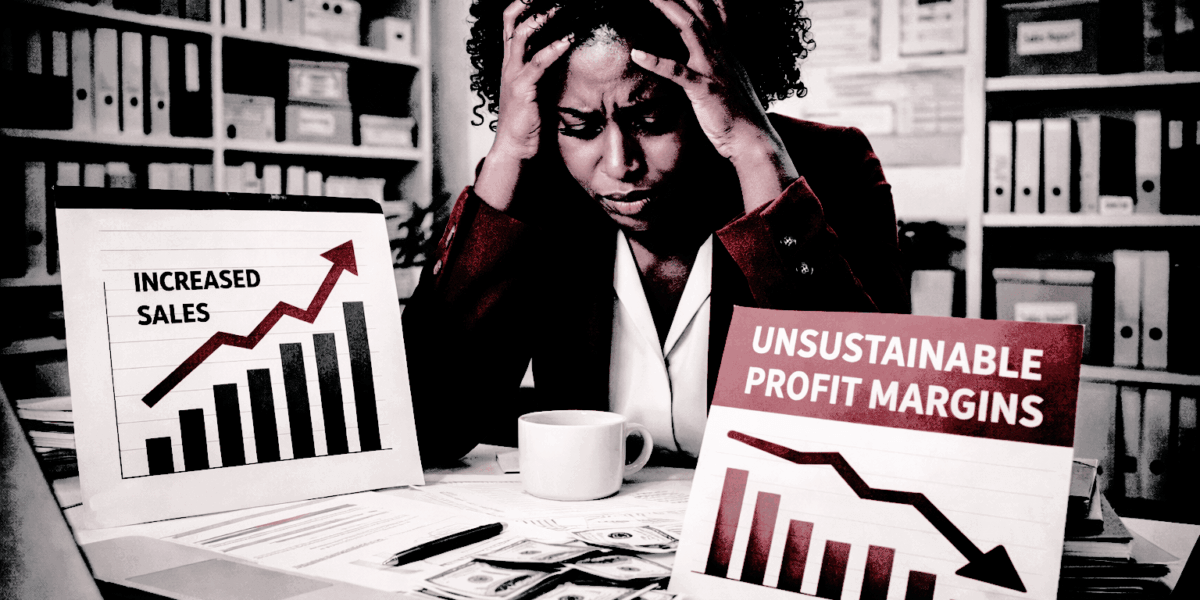
Urban Essentials is a niche home goods retailer in the e-commerce/retail space. It faced the challenge of dwindling profit margins despite increasing sales volume.
Our solution was to comprehensively overhaul its pricing strategy by leveraging Activity-based costing (ABC), resulting in a 42% increase in net profits within 90 days without raising baseline prices.
The Situation: A Success Story That Wasn’t Profitable
When Paula Gilbert launched Urban Essentials, an e-commerce store specializing in sustainable home goods, her focus was simple: get products to customers, build a brand, and grow revenue. Within two years, the business was processing 500+ orders monthly with revenue approaching $1.2 million annually. On paper, it looked like a success story.
But there was a problem Paula couldn’t ignore: her bank account told a different story from her revenue reports. Despite increasing sales month over month, profit margins were shrinking. Some months, Paula actually lost money on her best-selling products. The business was surviving on cash flow rather than genuine profitability, and Paula couldn’t pinpoint exactly where things were going wrong.
“I knew my pricing wasn’t working, but I didn’t know why,” Paula explains. “Every time I thought I’d solved one problem, like shipping costs from my supplier, another would appear, like customer delivery fees eating up my margins. I was constantly playing whack-a-mole with my pricing.”
The Complexity: A Web of Interconnected Costs.
When our consulting team began working with Paula, we identified that Urban Essentials faced a multi-layered pricing challenge that affected every part of the business:
Supplier Transportation Costs:
Paula sourced products from three different suppliers, each with different shipping terms. One supplier offered “free shipping” but built it into product costs. Another charged actual freight, which fluctuated wildly. A third required Paula to arrange her own shipping. The inconsistency made the true product cost nearly impossible to calculate.
Customer Delivery Complexity:
Urban Essentials offered “free shipping” on all orders over $50, a common tactic to increase average order value. However, product sizes and weights varied dramatically. Shipping a small candle costs $4.50, while shipping a large ceramic planter costs $18.00. The flat $50 threshold meant Paula was losing money on every single large-item order.
Discount-Driven Customer Behavior:
To attract customers, Paula ran frequent site-wide promotions: 15% off first orders, 20% off holidays, and 10% off for email subscribers. Customers had learned to wait for discounts, rarely paying full price. The compounding effect of these discounts on already-thin margins was devastating.
Hidden Operational Costs:
Beyond product and shipping costs, Paula hadn’t accounted for:
· Payment processing fees (2.9% + $0.30 per transaction)
· Return handling costs (15% of orders were returned)
· Packaging materials
· The true cost of her time spent on customer service
· Marketing acquisition costs attributed to each product category
“The problem wasn’t that Paula had bad prices,” explains our lead consultant. “The problem was that she had no idea what her prices actually needed to be. She was pricing in the dark and hoping for the best.”
The Consulting Approach: From Guesswork to Clarity.
Our engagement with Urban Essentials followed a structured three-phase approach designed to untangle the pricing complexity and build a sustainable profit model.
Phase 1:
Activity-Based Costing Analysis
We began by deconstructing every cost associated with getting a product from the supplier to the customer. For each of Urban Essentials’ 47 SKUs, we calculated:
· True landed cost: Product cost + supplier shipping + import fees + storage
· Fulfillment cost: Pick-and-pack labor + packaging materials
· Delivery cost: Actual shipping cost by zone and package weight
· Transaction cost: Payment processing fees + platform fees
· Post-purchase cost: Return rate percentage + customer service time
· Acquisition cost: Marketing spend attributed to each product category
What emerged was startling. Products that Paula believed were her bestsellers were actually losing money once all costs were factored in. A $45 ceramic planter that cost $18 from the supplier actually cost $52 to deliver to a customer on the West Coast after accounting for shipping, returns, and marketing, resulting in a $7 loss on every sale. “We had never looked at costs this granularly,” Paula admits. “I was so focused on top-line revenue that I missed the fact that I was literally losing money on my most popular items.”
Phase 2:
Customer Segmentation & Behavioral Analysis
Next, we analyzed purchasing patterns to understand how customers actually shopped:
· 40% of customers used discount codes
· Average discount applied was 18%
· Discount users had a 30% higher return rate
· Free shipping threshold drove cart additions, but often of low-margin items
· Customers in Zone 8 (farthest regions) cost 3x more to ship than local customers
This analysis revealed a critical insight: Urban Essentials’ pricing strategy was rewarding the wrong customer behaviors. The most profitable customers, those paying full price for smaller items, were effectively subsidizing the least profitable customers who waited for discounts and ordered large items with free shipping.
Phase 3:
Strategic Pricing Model Development.
With clear data on true costs and customer behavior, we developed a tiered pricing strategy that protected margins while maintaining market competitiveness:
- Product-based Margin Requirements:
We established minimum margin requirements by category:
· Small items (under 1 lb): 50% margin minimum,
· Medium items (1-5 lbs): 60% margin minimum,
· Large items (over 5 lbs): 70% margin minimum.
We established minimum margin requirements by category:
· Small items (under 1 lb): 50% margin minimum
· Medium items (1-5 lbs): 60% margin minimum
· Large items (over 5 lbs): 70% margin minimum
We established minimum margin requirements by category:
· Small items (under 1 lb): 50% margin minimum
· Medium items (1-5 lbs): 60% margin minimum
· Large items (over 5 lbs): 70% margin minimum
This ensured that every product category could cover its associated costs.
2. Dynamic Shipping Strategy
Rather than a single “free shipping” threshold, we implemented:
· Free shipping on orders over $75 (increased from $50)
· Tiered shipping rates based on actual cost plus 15%
· Free shipping exclusions for oversized items (clearly communicated)
· Zone-based pricing for remote areas
3. Strategic Discount Restructuring
We transformed the discount approach from reactive to strategic:
· Eliminated site-wide sales entirely
· Created category-specific promotions for high-margin items only
· Developed a loyalty program rewarding purchase frequency, not discount depth
· Bundled slow-moving items with popular ones to clear inventory profitably.
3. SKU-Level Profitability Monitoring
We implemented a simple dashboard tracking profitability at the individual product level, with alerts when any SKU dipped below margin requirements.
Implementation:
Making the Change Without Losing Customers
The biggest concern Paula had was that customers would reject the new pricing structure. After all, she was effectively raising prices for many customers while eliminating the discounts they’d come to expect. Our implementation strategy focused on communication and value reinforcement:
· 30-day advance notice of shipping policy changes was emailed to all customers
· Educational content explained how sustainable pricing supports quality products
· Grandfathered pricing for existing loyalty members on their first order after changes
· Enhanced product descriptions emphasizing value and quality to justify prices
· Bundled offerings that maintained perceived value while improving margins
“We held our breath for the first month,” Paula recalls. “We expected a backlash. Instead, our customers understood. Many actually appreciated that we were being transparent about pricing. Our customer service emails actually decreased because people weren’t confused about shipping costs anymore.”
The Results: Sustainable Profitability Achieved.
Within 90 days of implementing the new pricing strategy, Urban Essentials experienced a dramatic transformation:
| Metric | Before | After 90 days | % Change |
|---|---|---|---|
| Net Profit Margin | 4.2% | 16.8% | +300% |
| Average Order Value | $52 | $78 | +50% |
| Discount rate | 18% | 4% | -78% |
| Shipping costs as a % of revenue | 2% | 11% | -50% |
| Customer Acquisition Costs | $34 | $28 | -18% |
| Monthly Net Profit | $3,800 | $16,200 | +326% |
Perhaps most importantly, revenue remained stable while profitability soared. Urban Essentials was no longer a business that looked successful on the surface but struggled underneath.
“The shift in my mindset was as important as the financial results,” Paula reflects. “I used to lie awake worrying about cash flow. Now I sleep well knowing that every single sale contributes to our bottom line. I understand my business at a level I never did before.”
Key Lessons for E-commerce Business Owners.
- Revenue is vanity, profit is sanity.
High sales volume means nothing if the underlying unit economics don’t work. - All customers are not created equal.
Some customers are inherently more profitable than others. Know the difference and market accordingly. - Shipping is not a commodity.
Treat shipping as a core part of your product cost, not an afterthought. If you don’t know your exact delivery costs by product and zone, you’re pricing blind. - Discounts have a dark side.
Every discount trains customers to wait for the next sale. Strategic discounting preserves margins while maintaining customer relationships. - Complexity requires clarity.
When multiple cost factors interact, simple pricing formulas fail. Invest in understanding the true economics of each product.
Conclusion: From Survival to Strategy
Urban Essentials transformed from a business surviving on hope to one thriving on data-driven strategy. By untangling the complex web of supplier costs, delivery expenses, and discount behaviors, Paula Gilbert gained something more valuable than increased profits: peace of mind and a clear path forward.
Today, Urban Essentials continues to grow, but now with a foundation that ensures every sale contributes to long-term sustainability rather than short-term cash flow. The business has since expanded to 85 SKUs, opened a second warehouse to optimize shipping zones, and maintained profitability even as e-commerce shipping costs have continued to rise.
As Paula puts it: “I used to think pricing was just about covering costs and staying competitive. Now I understand that strategic pricing is the difference between working for your business and having your business work for you.”
Ready to Untangle Your Pricing Complexity?
Every e-commerce business faces unique pricing challenges. Whether you’re struggling with supplier costs, delivery logistics, discount management, or all of the above, our consulting team can help you develop a pricing strategy that ensures sustainable profitability.
For a complimentary profitability assessment, please reach out
Disclaimer: The names of the business owner, company, and location have been changed to protect the confidentiality of the engagement.